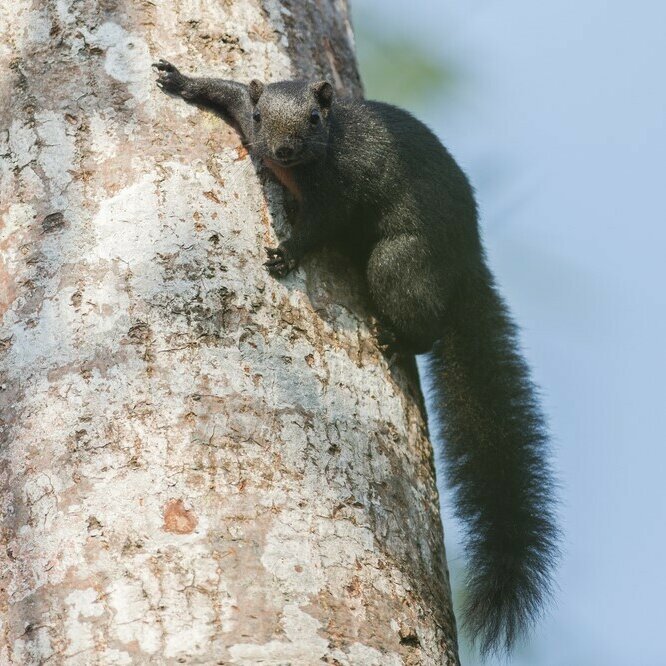
Pallas’s Squirrel
Callosciurus erythraeus
Identification #
Medium sized tree-squirrel with morphological features that vary across sub-species and geographic location. Some sources suggest that Callosciurus erythraeus can be distinguished from other species based on a combination of size (largest tree squirrel from north-east India), ventral colours (can vary from dark maroon, bright-red to pale creamy-buff), and an olive brown-agouti dorsum. The tail color and ear colors can also be variable across sub-species. Unlike the plantain squirrel (Callosciurus notatus), this species lacks the white lateral markings.
Distribution #
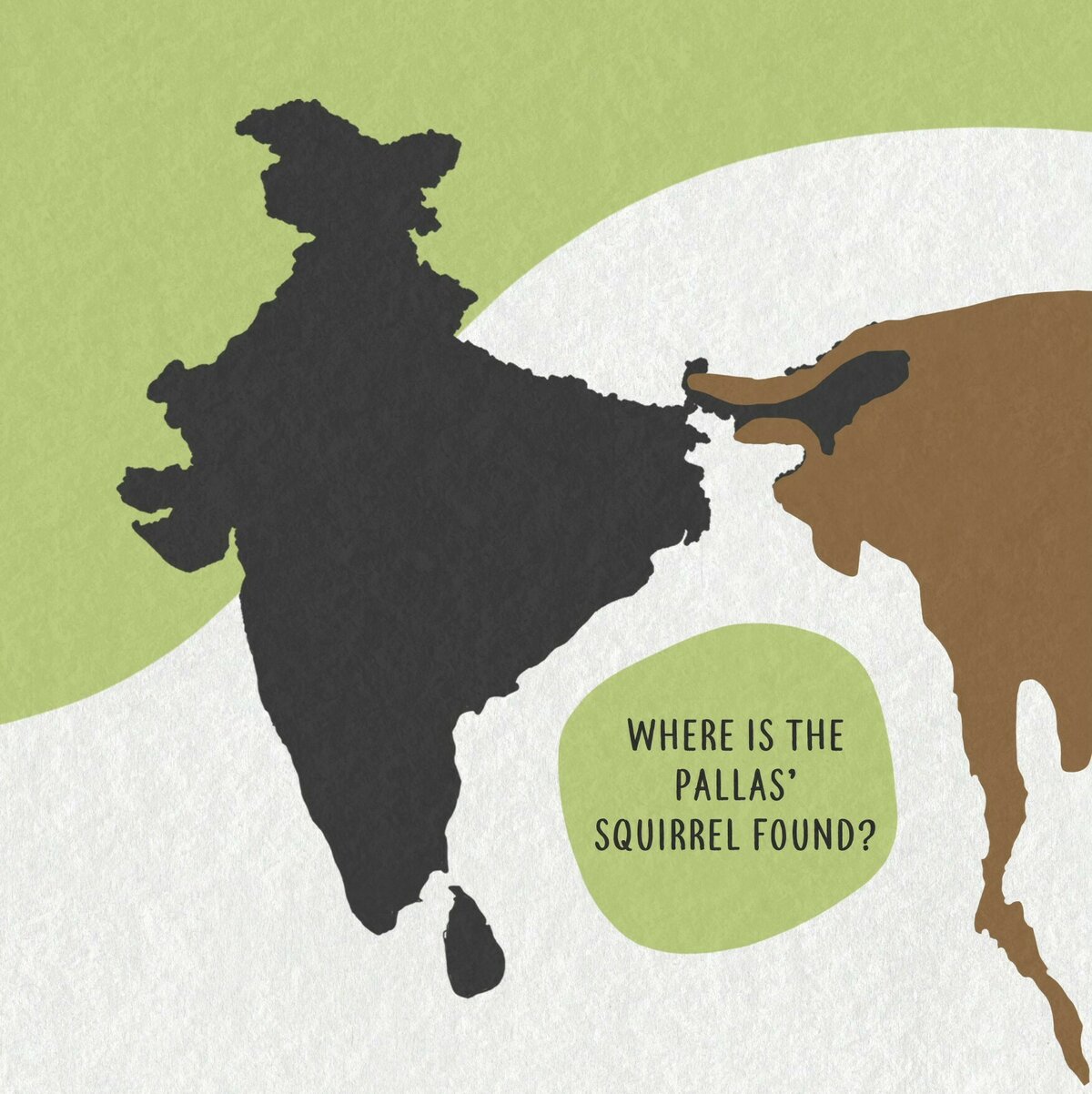
The species is distributed in South-Eastern China, Myanmar, Thailand, India, and the Malay Peninsula. It has also been introduced to Europe and South America subsequently. Within India, it is distributed in the states of Tripura, Mizoram, Assam, Meghalaya, Arunachal Pradesh and Nagaland with potentially three subspecies.
Habitat #
Inhabits a wide variety of habitats such as subtropical, montane, evergreen, and broadleaf forests with a high occurrence of fruiting trees. The species can also be found in conifer forests, scrub forests, and urban gardens in India although to a lesser extent.
Diet #
Like most tree squirrels, the species feeds predominantly on arboreal foods such as seeds, flowers, fruits, and leaves. In the forests of Dehing-Patkai of Assam, the species has been observed to feed on the seeds of Dipterocarpus macrocarpus, Terminalia bellirica, and the bark of many species of trees. In Japan, the species is known to adapt to seasonal changes and primarily feed on Camellia flowers in the winter (October-April), fresh leaves of plants in spring and fruits of various trees in the summer and rainy season. It occasionally eats insects and bird eggs to supplement its diet. The species has also been documented to hoard seeds for consumption during unfavourable circumstances in Sichuan, China.
References #
Duckworth, J.W., Timmins, R.J. & Molur, S. 2017. Callosciurus erythraeus. The IUCN Red List of Threatened Species 2017: e.T3595A22254356. https://dx.doi.org/10.2305/IUCN.UK.2017-2.RLTS.T3595A22254356.en. Accessed on 18 February 2026.