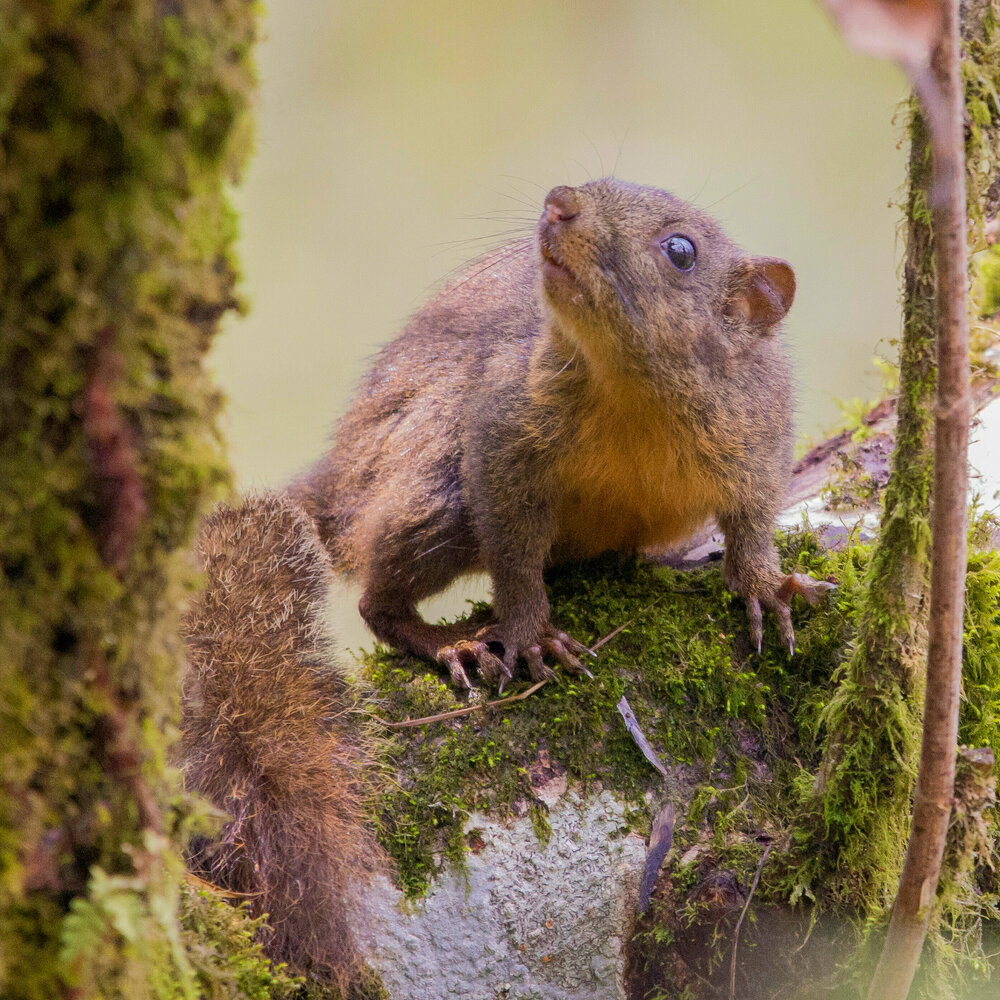
Orange-bellied Himalayan Squirrel
Dremomys lokriah
Identification #
This squirrel has dark rufous-brown fur on its back, sometimes speckled with dark yellowish-brown markings. Cheeks and hips can sometimes have reddish colouration. The ventral surface, or belly, can vary from pale to bright orange or yellow. A recent systematic study recognises eight different subspecies of Dremomys lokriah based on variation in pelage colouration and skull morphology, of which six are distributed in India. In some subspecies, the throat can be buff white, and the ventral part of the tail can be orangish.
Distribution #
It is found in montane forests (1500–2700 m) of Northeast India (Arunachal Pradesh, Sikkim, Meghalaya), extending westwards into Nepal and Bhutan, and eastwards into Myanmar and China (Yunnan).
Habitat #
The species can be recorded from sea level to 3400 m, but it is mostly seen between 1500 and 3400 m asl. It occurs in a diversity of habitat types. This includes subtropical montane evergreen forests, broadleaved forests, moist semi-deciduous forests, oak-rhododendron forests, rhododendron forests, and bamboo, conifer forests (fir and pine).
Vocalization #
It has a loud cackling call, described as a sharp, squeaky chatter, often repeated continuously.
References #
Molur, S. 2016. Dremomys lokriah (errata version published in 2017). The IUCN Red List of Threatened Species 2016: e.T6821A115084234. https://dx.doi.org/10.2305/IUCN.UK.2016-3.RLTS.T6821A22255622.en. Accessed on 18 February 2026.