Identification #
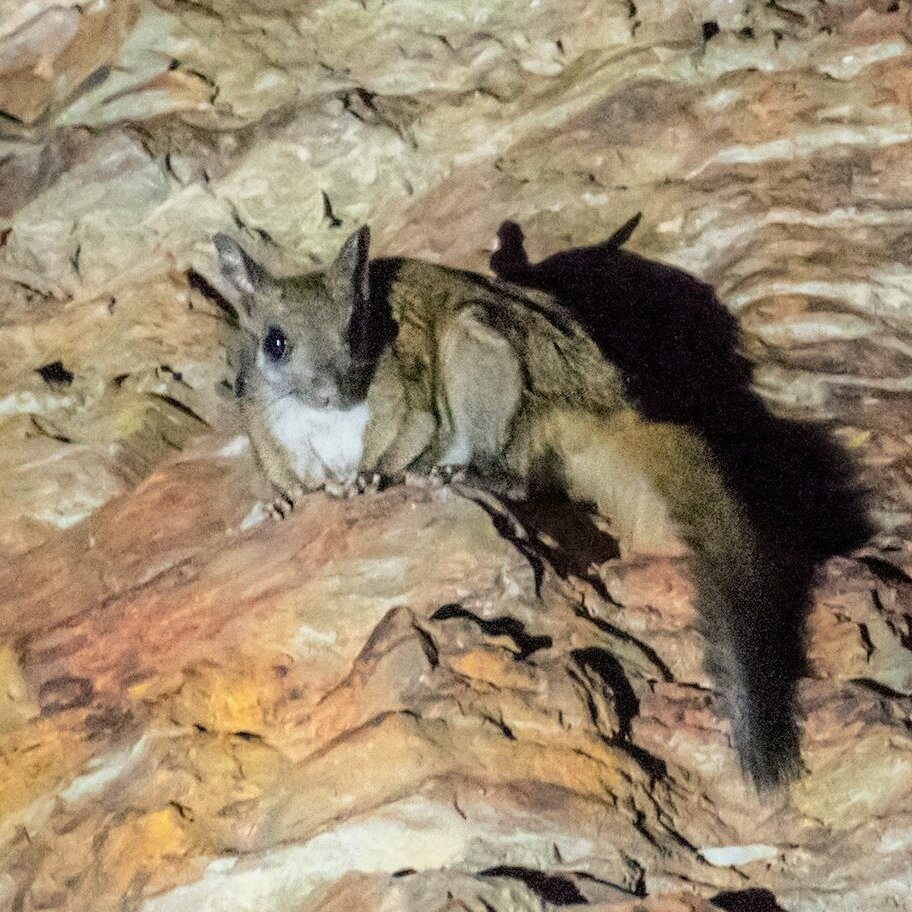
The back, or dorsal region, is dull grey or brown, mixed with black, giving an overall grizzled grey appearance. The cheeks, throat and underside are a creamy white to dull grey. The tail is broad and flat, with some black portions.
Distribution #
The species is known to occur in India, Pakistan and Afghanistan. In India, it is recorded from Jammu and Kashmir, Himachal Pradesh and Uttarakhand. It is believed to occur between 1800 and 3,500 metres above sea level.
Habitat #
The Kashmir flying squirrel occurs in the Himalayan moist temperate forests, dry coniferous forests, and landscapes with very few scattered trees. Their nesting sites are mostly tree holes, old dwellings or caves.
Diet #
They have been reported to feed on seeds, nuts, acorns, shoots and buds of conifer and deciduous trees, and one study found that they fed on over 20 species of conifer and deciduous trees.
References #
Molur, S. 2016. Eoglaucomys fimbriatus. The IUCN Red List of Threatened Species 2016: e.T7781A22248922. https://dx.doi.org/10.2305/IUCN.UK.2016-2.RLTS.T7781A22248922.en. Accessed on 20 February 2026.